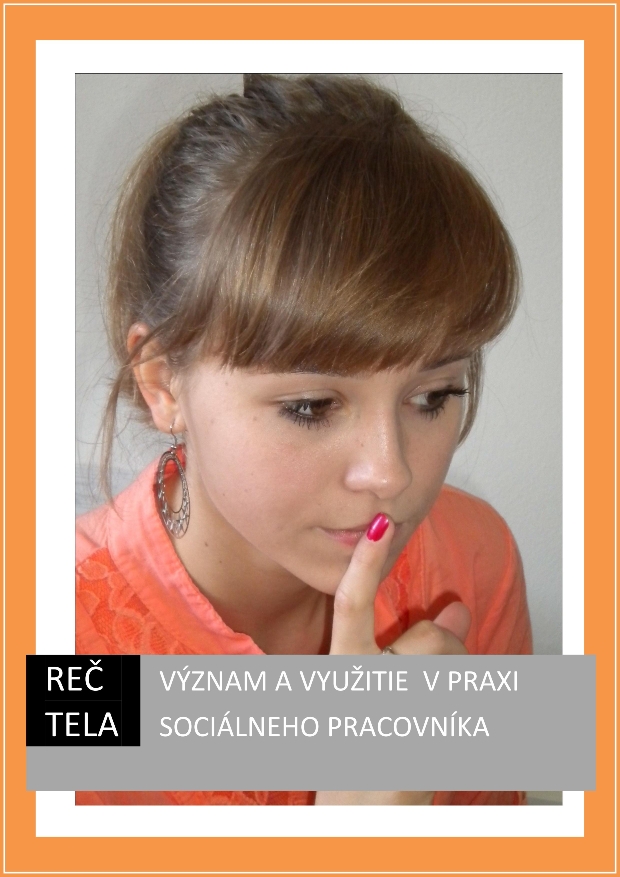
We bring you a publication in PDF, unique in Slovakia, specifically focused on body language in the field of social work. However, professionals and volunteers from other helping professions will also find inspiration in it, as well as managers, businesspeople, teachers, and all those who come into contact with people during the performance of their work. The publication contains a number of original illustrative photographs.
INTRODUCTION
The functionality, effectiveness, and success of the work of qualified professionals in the helping professions is directly proportional to the quality of communication. Effective communication provides the social worker with opportunities to obtain information necessary for quality management and personnel work, and in the social worker–client relationship it is a guarantee of mutual satisfaction (Gabura, J. – Gabura, P., 2004). Every communication takes place on two levels: verbal (spoken) and nonverbal. Gabura (2004, p. 108) states that "In verbal communication there is ample room for manipulation, shadow communication, and deliberate deception. According to experts, nonverbal communication is up to 90% more truthful than verbal communication when communicating feelings and relationships." Therefore, a social worker should have — in the interest of constructive work with the client — a basic orientation in the area of nonverbality, that is, body language. That is why we decided to offer the reader a publication unique in Slovakia, specifically focused on body language in the field of social work. However, professionals and volunteers from other helping professions will also find inspiration in it, as well as managers, businesspeople, teachers, and all those who come into contact with people during the performance of their work.
CONTENTS
- Body Language as a Communicator – The Basic Component of Every Communication
- Basic Signals of Body Language
- Closed and Open Posture
- Mirroring
- The Meaning of Hands and Palms in Body Language
- Universal Gestures
- Hands as Barriers
- Clasped Hands
- Displaying Thumbs
- Deception
- Fingers in the Mouth
- Boredom
- Evaluative Gestures
- Basic Postures
CONCLUSION
A social worker equipped with basic skills to read body language signals can use these abilities in communication with the client as a certain advantage, allowing them to always be one step ahead. In subconscious nonverbal communication through body language, specific gestures can be identified and through them the mood, internal state, or subsequent client behavior. Thus, even what is not expressed verbally provides important codes that, besides an aesthetic function, also carry a meaning function. A social worker can assess whether the client is open or closed; whether they are sincere; whether they are telling the truth; what psychological state they are in; whether they have genuine interest or are just pretending; whether they are timid, uncertain, afraid; whether they subconsciously signal tendencies toward flight, defense, or attack; whether they are superior, authoritarian; whether they feel threatened. Such important details often escape us, which prevents us from choosing adequate strategies in approaching the client with an effective outcome.
In trying to gain the client's trust and create a favorable atmosphere for mutual cooperation, a social worker can also be greatly helped by adopting and consciously using specific positive signals of their own body language.
In the individual chapters, we have subjected to a more detailed description specific emotions that are indicated in the client by specific body language signals. Based on their identification, the social worker can choose an effective strategy in approaching the client. It is necessary to realize, however, that body language must be perceived in all its complexity and intricacy. Individual gestures cannot be judged out of context, but always with regard to the specific situation and what the client is expressing verbally. Tense and rigid attribution of meanings to individual gestures may miss the desired effect. One must bear in mind the uniqueness of each person and their individuality. The facts and realities described in this publication can serve the social worker as a compass, as an aid for better understanding the client and for better orientation in the given situation.
Author: Mgr. Lenka Jalilah Hrušková
Scientific Editor: Mgr. Erika Moravčíková, PhD.
Publisher:
Business Intelligence Club, o. z.
http://www.clubbusinessintelligence.sk
Year of publication: 2013
Number of pages: 61
ISBN: 978-80-971388-0-6
